
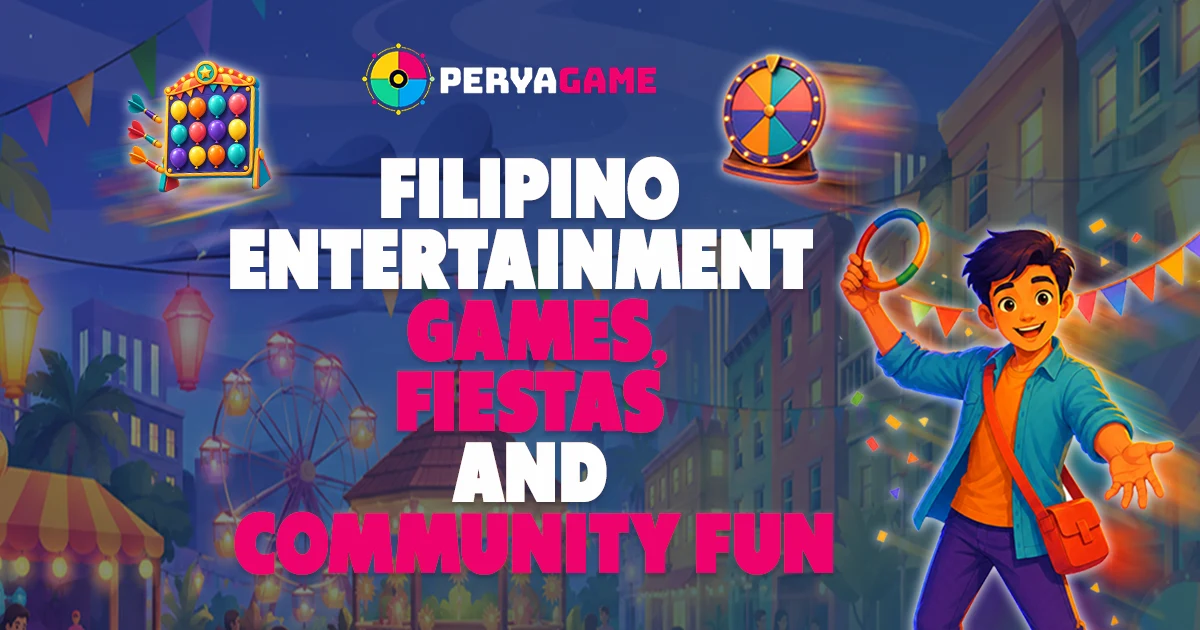
Entertainment in the Philippines comes in many forms.
Today, people can watch movies, stream videos, play mobile games, listen to music, or interact with friends without leaving home. But Filipino entertainment also has a long tradition of bringing people together in physical spaces.
Fiestas, fairs, games, performances, community celebrations, and amusement attractions have all contributed to how Filipinos spend their leisure time.
One familiar example is the perya.
For many communities, the arrival of a perya can add rides, games, food, lights, and other attractions to an already lively local celebration.
At PeryaGame, we explore this side of Filipino entertainment—particularly the relationship between games, fairs, fiestas, community experiences, and the transition from traditional to modern forms of amusement.
What Is Filipino Entertainment?
There isn’t one activity that defines Filipino entertainment.
The term can describe many forms of recreation enjoyed throughout the country, from traditional community activities to modern digital entertainment.
For PeryaGame, our coverage focuses primarily on entertainment connected with:
- Perya and carnival culture
- Traditional games
- Fiestas and community celebrations
- Amusement attractions
- Family and social activities
- Changing entertainment habits
- Digital adaptations of familiar entertainment concepts
This focus allows us to explore entertainment without losing sight of our main subject: the Filipino perya experience.
Traditional Entertainment in the Philippines
Before smartphones, streaming services, and social media became part of everyday life, entertainment relied much more heavily on physical interaction.
People attended celebrations, watched performances, participated in games, visited fairs, and gathered with family or neighbors.
Different regions and communities naturally developed different traditions.
As a result, it would be difficult to define a single “traditional Filipino entertainment experience.”
Instead, these activities reflect the diversity of Philippine communities.
Our guide to Traditional Filipino Entertainment explores these experiences in greater detail.
Fiestas as Community Entertainment
Fiestas are among the most recognizable community celebrations in the Philippines.
The nature of a fiesta depends on the community, occasion, and local traditions. Activities can include religious observances, processions, food, music, performances, markets, competitions, and entertainment.
In some locations, temporary amusement attractions can become part of the festivities.
This is where the relationship between the Filipino fiesta and perya becomes particularly interesting.
A perya may provide additional entertainment, but it exists within a much broader cultural and community event.
The Perya Experience
A perya brings several forms of entertainment together in one temporary location.
Visitors may encounter:
Games + Rides + Food + Lights + Music + Social Interaction
Some people arrive primarily for the rides.
Others want to try the games.
Some simply walk around with friends or family and enjoy the atmosphere.
This combination makes the perya an interesting example of entertainment that depends heavily on physical surroundings and shared experience.
Readers interested in the complete subject can explore our Filipino Perya guide.
Games as Filipino Entertainment
Games are another important part of recreational culture.
At a perya, games may involve throwing, aiming, spinning, shooting-style amusement mechanics, or completing other simple challenges.
Their accessibility contributes to their appeal.
Many carnival games can be understood quickly without lengthy instructions or previous experience.
But not all games operate the same way.
Some primarily test skill.
Others involve chance.
Some combine both.
Our Perya Games pillar explores these distinctions and documents different types of games found in carnival environments.
Family and Social Entertainment
Entertainment doesn’t always revolve around the attraction itself.
Sometimes the people you’re with are what make an experience memorable.
A family might visit a local fair together. Friends might challenge each other at a game booth. Parents might watch their children enjoy an amusement ride.
These interactions make community entertainment different from many solitary forms of recreation.
The activity provides the setting, but the social experience can become the lasting memory.
Carnival Culture in the Philippines
Carnival-style entertainment brings together several concepts under one setting.
Temporary attractions, colorful decorations, games, prizes, food, music, and rides contribute to an environment designed around amusement.
The Filipino perya represents a local expression of this broader fair and carnival concept.
However, individual peryas can vary significantly depending on their location, operator, size, and the celebration surrounding them.
Understanding these differences helps avoid treating every Philippine fair as though it offers exactly the same experience.
How Filipino Entertainment Has Changed
Technology has transformed leisure.
Television brought entertainment into homes.
Personal computers introduced interactive digital experiences.
Internet access expanded the amount of information and entertainment available.
Smartphones then placed many of these experiences into a device people could carry throughout the day.
Today, a person can access videos, music, social networks, and games almost instantly.
Yet this doesn’t necessarily mean traditional entertainment has been replaced.
Instead, physical and digital entertainment can exist alongside each other.
Traditional vs Digital Entertainment
The differences can be simplified:
| Traditional/Physical | Digital |
|---|---|
| Requires a physical location | Accessible through a device |
| Face-to-face interaction | Remote or online interaction |
| Physical equipment | Software-based experiences |
| Community environment | Individual or virtual environment |
| Limited by place and schedule | Often available on demand |
Neither format represents all Filipino entertainment.
Instead, they show how technology has expanded the ways people can spend their leisure time.
From Physical Games to Digital Experiences
Some traditional entertainment concepts have also influenced digital games.
A physical wheel can become an animated wheel.
A carnival-style challenge can inspire a mobile game mechanic.
Themes associated with fairs can appear in digital graphics and interfaces.
But a digital game shouldn’t automatically be considered equivalent to a traditional perya attraction.
Digital amusement games, skill games, chance-based activities, and real-money products can operate very differently.
Our Online Perya Games section examines this transition separately.
Why Traditional Entertainment Still Matters
Traditional entertainment can provide something technology doesn’t completely reproduce: a shared physical environment.
At a perya, visitors experience the same lights, sounds, rides, food, crowds, and activities.
During a fiesta, entertainment takes place within the context of a larger community celebration.
These experiences can also provide useful insight into how previous generations spent their leisure time.
Documenting them therefore isn’t only about nostalgia.
It helps preserve information about changing aspects of Filipino popular culture.
Exploring Filipino Entertainment With PeryaGame
Filipino entertainment continues to evolve.
Traditional games remain recognizable while digital entertainment introduces new ways to play. Fiestas continue bringing communities together, while smartphones make entertainment available almost anywhere.
PeryaGame focuses on the space where these subjects meet.
Explore our resources about traditional Filipino entertainment, fiesta activities, carnival culture, Perya Games, Filipino Perya, and the evolution of entertainment in the Philippines.